
Our Commercial Director, Ashley Simpson, was recently invited to share his insights at a Cosmetics Business event. As a company that has been at the forefront of multi-page labels for over 45 years, we have a unique perspective on the trends and challenges facing the cosmetics industry. From tackling complex packaging legislation to helping brands communicate directly with their customers, we thought we’d share his insights with you here.
Our story began in 1945 as a general printing business in Bury St Edmunds, UK. But in 1977, we had a significant breakthrough that would change everything. The idea came from a simple problem facing an agrochemical company: how to ensure product information stayed on the packaging throughout its lifecycle. The existing solution – a folded leaflet held on with a rubber band – was easily lost.
In a moment of innovation, we devised the idea of sticking the folded leaflet onto a self-adhesive label. And with that, Fix-a-Form® was born. Since then, the product has evolved based on our customers’ challenges. Our developments have been driven by your needs, from creating booklet constructions up to 48 pages to making a product as small as 25mm in diameter.
In the last decade, the use of Fix-a-Form® in the cosmetics industry has grown, largely in response to new legislation and export requirements. The most common challenge we see is how to fit more legislative information onto packaging without ruining its carefully designed aesthetics.
Often placed discreetly on the back of a carton or the lid of a bottle, a Fix-a-Form® label is more than just a functional piece of secondary packaging. It offers brands a unique space to communicate directly with their customers. You can provide more comprehensive application instructions, include easy-to-read ingredients tables, and use pictograms to guide the consumer. Best of all, the resealable closure means the information can be referred to repeatedly.
This technology is also an excellent solution for export labelling. It can carry multiple languages on a single label, which can help you minimise the number of different SKUs you need to produce and hold in stock.
For a few years now, I’ve seen what I perceive as “greenwashing” – vague references to products being “eco-friendly” or “natural” with little-to-no proof. As an industry, we need to be more honest about the trade-offs involved. For example, is recycled paper truly environmentally friendly if its manufacturing process uses significantly more energy?
Reducing the environmental impact of packaging requires a collective effort. One area you can directly impact is ensuring your packaging is not constructed of mixed materials that cannot be easily separated in the waste stream. An example is using foil on a paper label; while the paper can compost in weeks, the foil will not.
In recent years, we’ve seen a noticeable move towards “deplasticfication” in packaging, with inner trays made from rigid board and major brands like Nestlé and Lego trialling paper-based alternatives.
However, plastic shouldn’t always be seen as the enemy. It is a durable, low-cost material that can preserve a product for longer and ensure it is transported safely. For many cosmetic products, there is simply no alternative. When a plastic label is adhered to a plastic container, it can make it easier to sort in the recycling waste stream, highlighting how a mindful approach to materials can lead to more sustainable outcomes.
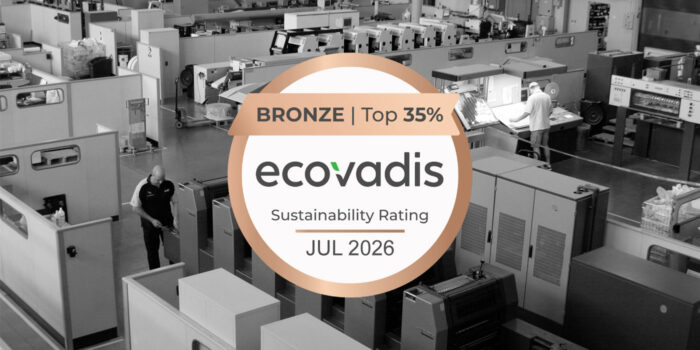
Beyond the materials themselves, the ethical practices of your suppliers play a crucial role. While it’s nearly impossible to avoid a carbon footprint, we believe it’s our responsibility to minimise it. For our part, we’ve invested heavily in renewable energy, including installing 1,800 solar panels on our factory roof. During the summer months, we are largely self-sufficient, even selling excess electricity back to the grid.
When choosing a supplier, it’s worth visiting their manufacturing site to see if their ethos truly matches your brand’s. While it’s easy to pay for an offsetting scheme, true commitment to sustainability and ethical practice is reflected in a company’s actions and investments.
And I hope you found my “industry insights” of interest. If you’d like to explore how our labels can help solve your packaging challenges, please feel free to get in touch.
Ashley Simpson, Commercial Director