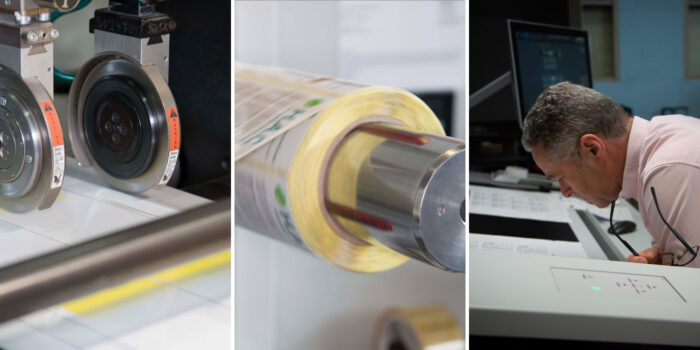

Safety is of paramount importance to a number of industries, few more so than pharmaceuticals. The nature of products produced within the pharmaceutical sector means that even the slightest change in temperature or storage conditions could render an item unsafe.
The ever-increasing danger of counterfeit products also poses a risk to the industry, but could the solution to both issues be found in the form of thermochromic ink?
Thermochromic technology enables a broad range of labels to be produced that are designed to change colour or disappear if the product is exposed to a change in temperature. A specific trigger temperature will make the print features disappear or appear when they have been exposed to heat, and therefore warn the user that the product may have been stored incorrectly or tampered with.
Organic, carbon-based chemicals called Leucodyes exhibit a specific colour that, subject to a change in temperature, will change or become invisible. This is due to the molecular structure of Leucodyes altering between two subtly differently states, coloured and colourless.
Labels of this kind are often utilised in instances where products need to be stored in specific conditions. Some pharmaceuticals need to be kept cool, for example, and if stored at warmer temperatures could be compromised and rendered useless. Thermochromic labelling provides a guarantee that the product itself is safe to use.
Heat sensitive inks of this kind are just one of a number of safety features that Denny Bros can apply to our labels. We also have a range of labelling that is compliant with the Falsified Medicines Directive (2011/62/EU) regarding packaging for prescription drugs and high-risk over-the-counter medicines.
The Falsified Medicines Directive (FMD) is a set of rules to protect people from fake medicines in the European Union (EU). It includes additional anti-tampering security on packaging, and tracking of medicines using a unique identifier, such as a barcode, to identify and authenticate individual products.
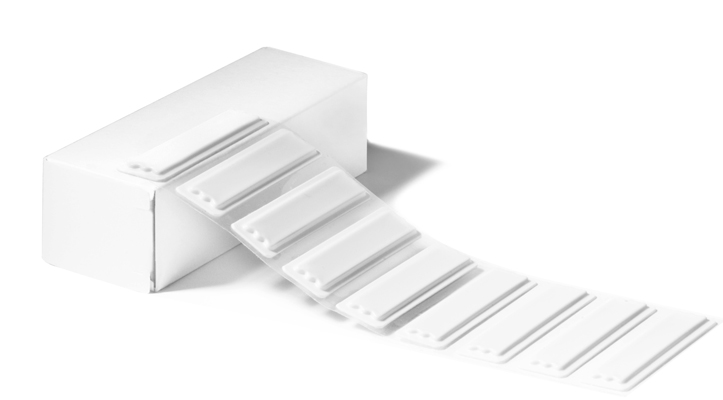
Supplementary approaches include featuring holograms on labels or applying silver foil to a product, which are both extremely hard for counterfeiters to replicate.
Another method for deterring counterfeiters involves the use of fluorescent inks on labels that will only reveal hidden information when exposed to UV light.
2D matrix encoding can be used on labels, which consists of black and white cells or modules arranged in either a square or rectangular pattern, which correspond to certain text or numeric data.
In addition, radio frequency identification (RFID) tags can be incorporated into labels or within packaging, so products can be tracked and located, while acoustic tags and magnetic security strips can be easily attached to high value items to deter shoplifting and theft.